A detailed overview of my teaching philosophy, teaching
strategies, university teaching experience, pedagogical
development, and approach to engineering education.
1. Teaching Philosophy
In order to ignite student motivation, which fosters understanding, and to build competences within a subject,
it is not sufficient for the teacher to master the content alone.
A teacher must also foster a learning environment where students are
encouraged to explore, question, and apply knowledge in meaningful ways (Bruner, J. 1966).
I believe that effective teaching extends beyond delivering subject
content. A teacher should create a learning environment where students
are encouraged to explore; particularly when students are adapting
to new educational and cultural environments.
My teaching approach combines active learning with structured
explanations. I typically begin a topic with a simple, general example
that introduces the concept, followed by the relevant theoretical
foundations. I then connect the theory to real-world, engineering and
question-based examples, encouraging students to participate through
discussion and, hands-on activities, where appropriate.
This approach is intended to help students develop confidence and
independence in their learning while encouraging critical thinking and
collaboration. Ultimately, my goal is not only to support knowledge
acquisition, but also to help students develop the skills and mindset
needed for their academic and professional careers.
Through interactive discussion and practical activities,
students are encouraged to participate actively and apply
the concepts they have learned.
2. Teaching Strategies & Methods
My teaching strategies are designed to align closely with my
philosophy of fostering motivation, understanding, and competence.
I aim to create an engaging, student-centered learning environment
where students actively construct knowledge and apply it to
real-world problems.
Micro-Lecture Videos and Pre-Lecture Preparation
I provide students with pre-lecture materials through Moodle,
including reference videos, recorded micro-lectures, and lecture
slides with key points. These resources introduce key concepts
before the main lecture, allowing students to become familiar with
the topic and prepare questions in advance.
This approach accommodates different learning preferences, as some
students benefit from text-based materials while others benefit
from visual or multimedia content. By providing lecture materials
in advance, students can focus during the lecture on understanding
concepts, participating in discussion, and applying their knowledge
rather than simply transcribing notes.
Sample micro-lecture provided as pre-lecture learning material
Active Note-Taking and Personalization
During lectures, slides are gradually developed, and students are
encouraged to develop their own lecture notes. This promotes active
engagement, critical thinking, and deeper processing of the
material. Students learn to organize information in ways that make
sense to them, supporting long-term retention and independent
learning.
Real-World Examples and Question-Based Learning
Each section begins with a compelling, real-world general example related to the topic,
providing practical context and capturing students' attention.
I then provide structured explanations, starting with a simple example that leads into the theoretical concepts,
followed by applied-engineering and question-based examples that encourage students to think critically
and apply the concepts they have studied.
Through interactive discussion, students are encouraged to participate
actively and develop the ability to explain and analyse the examples
themselves. This provides opportunities for students to connect theoretical
concepts with practical situations and develop confidence in solving
engineering problems independently.
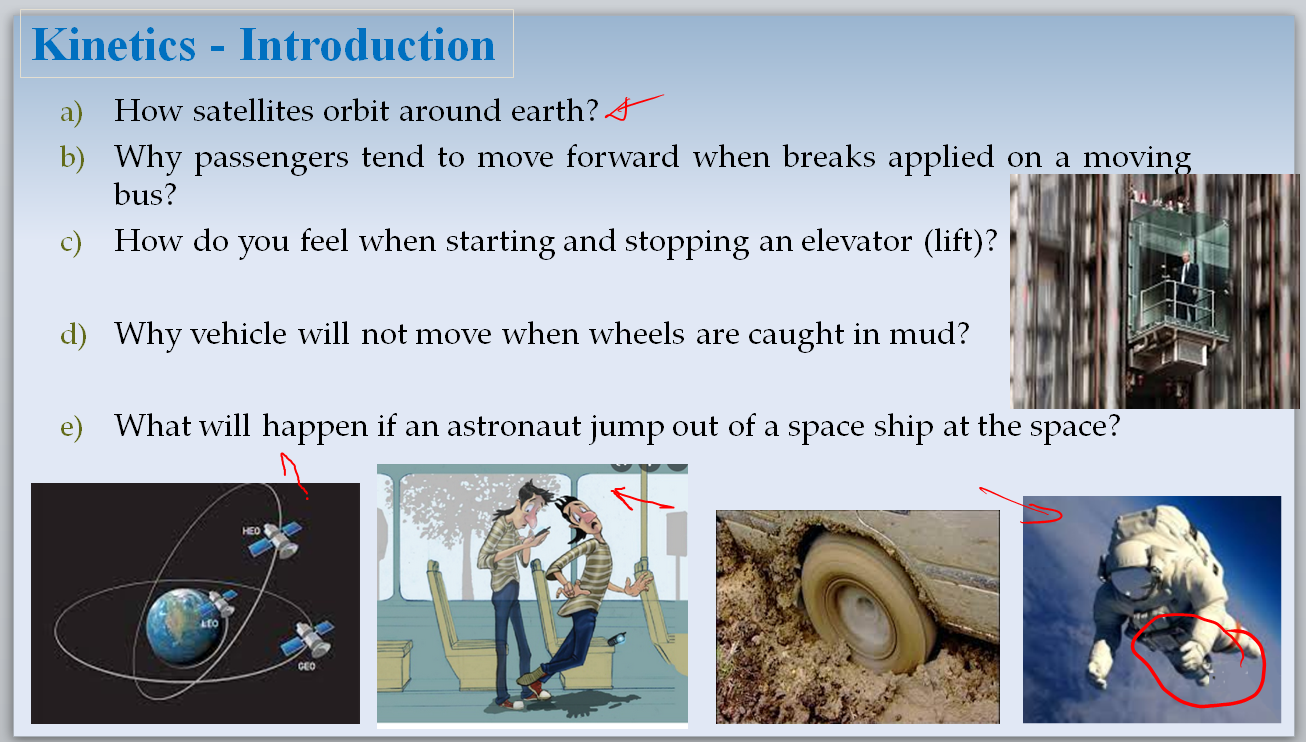
Example 1 — Introducing kinetics through real-world questions.
Familiar situations such as satellite motion, braking in a bus,
elevator motion, and vehicles stuck in mud are used to introduce
the concept of kinetics.
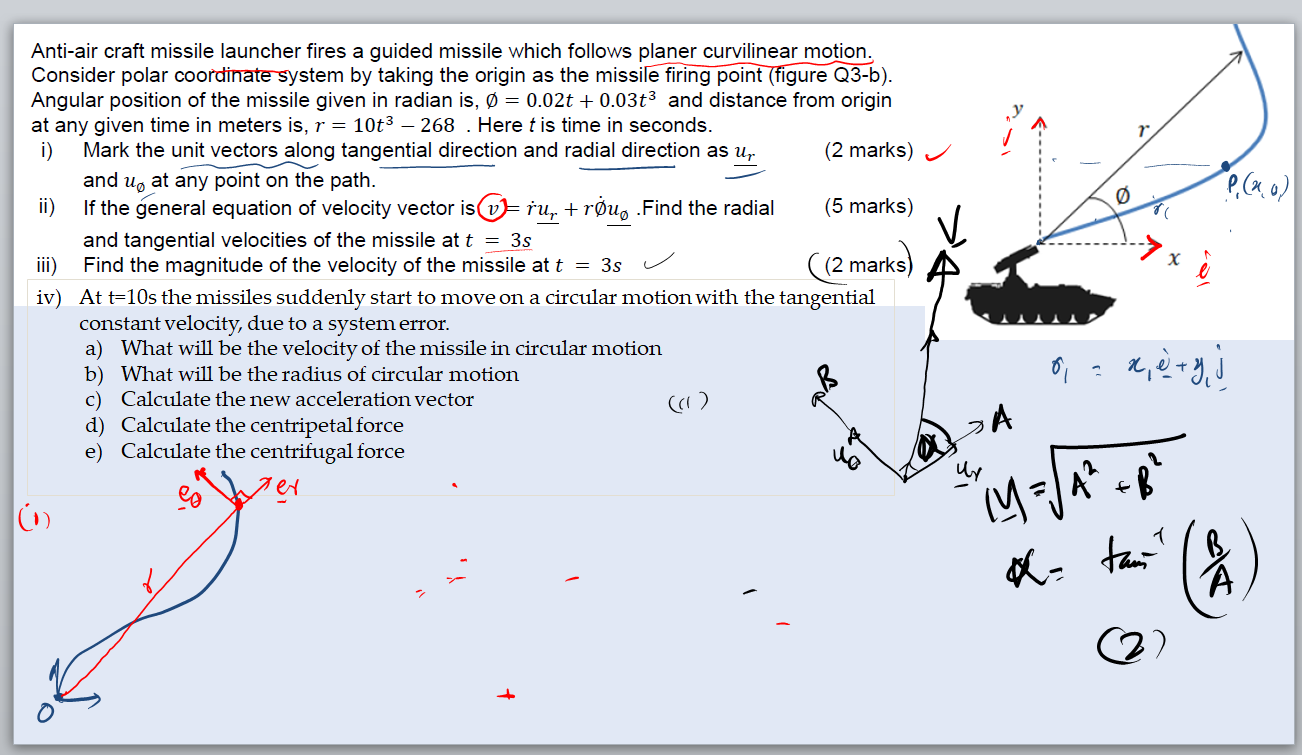
Example 2 — Moving to a real engineering problem with extensive mathematical analysis.
A guided engineering problem is used to develop concepts including
polar coordinates, radial and tangential velocity, acceleration,
and circular motion.
Tutor Sessions for Focused Guidance
For subjects involving extensive calculations and problem-solving, I conduct (with help of demonstrators)
separate tutor sessions with smaller groups. These sessions provide students
with focused guidance and additional opportunities to work through problems,
ask questions, clarify difficult concepts, and build confidence in applying
the theory independently.
Tutor sessions are generally followed by take-home assignments, giving
students an opportunity to work through problems independently and
demonstrate their understanding. After the submission deadline, I provide
detailed worked solutions, often as handwritten solutions, so that students
can compare their approaches with the correct solution, identify their
mistakes, and understand how to improve their problem-solving process.
I have found that handwritten worked solutions can also make complex
problems feel more approachable. Seeing the solution developed step by step
in a form similar to the work students produce themselves can help
communicate that difficult engineering problems can be solved through a
systematic process, encouraging students to develop confidence in their
own ability to solve them.
I view assessment not only as a means of measuring students'
knowledge, but also as an opportunity to reinforce learning through
practical application. Assessments are designed to encourage
students to apply concepts, work through problems, and demonstrate
their understanding.
Formative feedback plays an important role in my teaching approach.
I use feedback to help students identify areas for improvement,
reflect on their learning, and develop stronger critical-thinking
and problem-solving skills.
4. Student Support & Engagement
I maintain an open and approachable teaching style, providing
guidance and support as students work through course content and
navigate university learning environments. I aim to create an
atmosphere where students feel comfortable asking questions,
seeking clarification, and discussing challenges related to their
studies.
In addition to my teaching responsibilities, I also served as a
student counsellor within my department. This role provided me with
opportunities to support students beyond the classroom, including
listening to their concerns, providing guidance, and helping them
navigate academic and personal challenges that could affect their
university experience. This experience strengthened my understanding
of the importance of student wellbeing, empathy, and approachable
communication in effective higher education.
I also use digital learning environments such as Moodle to support
communication beyond the classroom. Discussion forums provide
students with opportunities to ask questions, participate in
collaborative discussions, and share ideas with their peers.
These interactions encourage peer-to-peer learning and contribute
to a more collaborative and interactive learning community. I
believe that effective student support involves not only helping
students understand the subject matter, but also creating an
environment in which they feel supported and confident in their
ability to learn.
5. Pedagogical Training & Development
Formal University Teaching Development
Induction Programme for Probationary Lecturers
Staff Development Centre · University of Kelaniya
~150 hrs Contact learning
I completed the Induction Programme for Lecturers
conducted by the Staff Development Centre of the University of
Kelaniya. This mandatory programme provided formal preparation for
university teaching and academic practice.
The programme covered teaching and learning methods, assessment
and evaluation, curriculum design and revision, ICT in higher
education, teaching practice, research in higher education,
student development and counselling, university administrative
procedures, and strategic planning and management.
Teaching & Learning Methods
Assessment & Evaluation
Curriculum Design & Revision
ICT in Higher Education
Teaching Practice
Higher Education Research
Student Development & Counselling
University Administration
Strategic Planning & Management
This training has contributed to the development of my approach
to student-centered teaching, course planning, assessment, and
reflective teaching practice.
Selected examples of teaching practice, instructional materials, and
problem-solving activities that demonstrate how I translate my teaching
philosophy into practical learning experiences.
Teaching Videos
These lecture videos were recorded during the COVID-19 pandemic in 2021–2022,
when online teaching was still a relatively new practice in our teaching environment.
The sessions were conducted using the limited infrastructure and resources available at the time,
demonstrating my ability to adapt teaching methods and learning materials to a rapidly changing educational environment.
My in-person teaching follows a more interactive approach, incorporating active discussion,
and direct student engagement.
These approaches allow greater opportunities for interaction, immediate feedback,
and active participation in the learning process.
Introductory lecture
It is important to create a strong first impression at the beginning of a onine lecture series.
Interation with students for student ideas, selecting external videos are used to capture attention,
stimulate curiosity, and create motivation to explore the topic.
This initial engagement provides a foundation for introducing the theoretical concepts that follow.
Explanation video using SOLIWORKS engine model
Demonstrating an internal combustion engine online can be challenging without access to a physical engine.
I therefore used a working SolidWorks model to demonstrate the main components and their operation,
helping students visualize the mechanisms and understand how the different parts work together.
This approach received very positive feedback from
students and was particularly useful in making the complex mechanical processes easier to understand.
Introduction to Kinetics
I begin with familiar real-world situations to help students develop an intuitive understanding of mechanics.
Examples such as satellite motion, vehicle braking, elevator motion, and astronaut
motion are used to stimulate discussion before progressively connecting these
observations to the fundamental concepts, mathematical formulation, and systematic problem-solving of mechanics.
Introduction to angular momentum
Discussion on the motion of rotating bodies, and energy conservation.
Refrigeration and A/C
Discussion on the heat transfer, heating loads and refrigeration theories.
Selected Lecture Material
Applied Thermodynamics-Heat transfer 01
A selection of lecture notes, presentation slides, and other
teaching materials developed for university engineering courses.
These materials illustrate how theoretical concepts are
structured and presented to students.
A selection of lecture notes, presentation slides, and other
teaching materials developed for university engineering courses.
These materials illustrate how theoretical concepts are
structured and presented to students.
A selection of lecture notes, presentation slides, and other
teaching materials developed for university engineering courses.
These materials illustrate how theoretical concepts are
structured and presented to students.
A selection of lecture notes, presentation slides, and other
teaching materials developed for university engineering courses.
These materials illustrate how theoretical concepts are
structured and presented to students.
Examples of engineering problems used to guide students from
theoretical concepts to practical application. Worked solutions
demonstrate the step-by-step reasoning and systematic approach
used in problem-solving.
I aim to further develop my teaching through
interdisciplinary approaches, particularly by connecting
engineering, biomedical data science, and applied
computational analysis.
I am also interested in developing student-centered and
blended teaching approaches and contributing to modern
engineering education environments.